
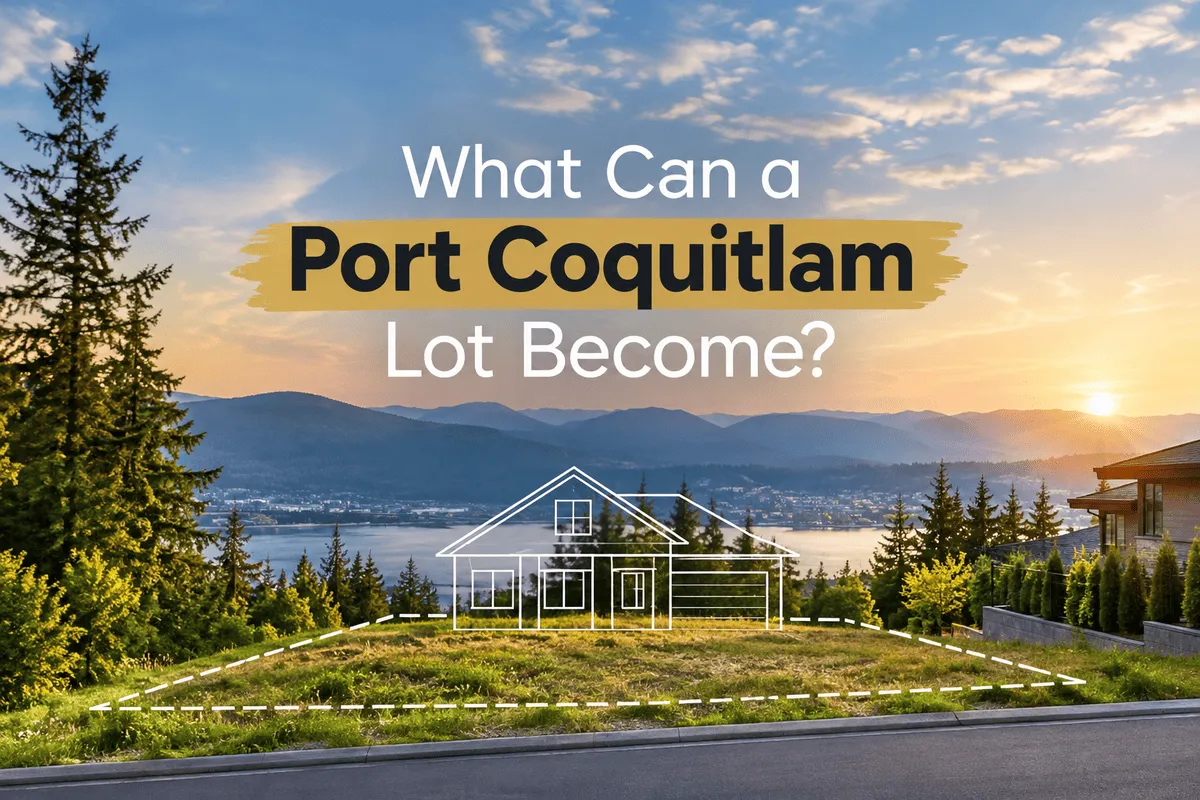
What Can a Port Coquitlam Lot Become?
A Port Coquitlam property is more than the house currently sitting on the land. The lot itself can influence what a property can support, how it may be used, and what questions a buyer should ask before making a decision.
For buyers, the important question is not simply whether a home looks good today.
It is:
What can this property realistically become?
That question can matter when comparing older homes, larger lots, properties with redevelopment potential, or homes that may need future improvements.
Start With the Lot
Before thinking about renovations or redevelopment, look carefully at the physical property.
Consider:
Lot size and shape
Access to the property
Existing buildings
Driveway and parking
Yard configuration
Trees and landscaping
Relationship to neighbouring properties
Nearby roads and lanes
Drainage or water-related considerations
A lot that looks spacious from the street may have limitations that are not immediately obvious.
The opposite can also be true. A property that appears ordinary at first may offer useful space for future improvements, depending on the applicable rules and the characteristics of the land.
This is why buyers should evaluate the land and the house together.
Zoning Can Change the Question
A property's potential is closely connected to its zoning.
The City of Port Coquitlam states that its Zoning Bylaw regulates land uses and establishes requirements for development. Buyers can check the property's zoning and Official Community Plan designation through the city's PoCoMAP resources.
That makes zoning one of the first things worth investigating when a property interests you.
Instead of assuming a lot can be divided, expanded, rebuilt, or used in a particular way, check what the applicable rules actually allow.
If a proposed use does not comply with the existing zoning, a rezoning application may be required. Other processes, including subdivision, development permits, or Official Community Plan amendments, may also apply depending on the proposal.
A Lot Is Not Automatically a Development Opportunity
The phrase "development potential" can sound attractive, but it should be treated carefully.
Owning a larger lot does not automatically mean that a buyer can create multiple properties or build whatever they want.
For example, Port Coquitlam's subdivision process has requirements involving property boundaries, minimum lot dimensions, servicing, and applicable zoning. The city also notes that different professionals and municipal departments can be involved in a subdivision application.
The better approach is to investigate the property before assigning a future use to it.
That means asking:
What is permitted now?
What approvals would be required for the intended change?
Does the physical property support that plan?
Those questions are more useful than simply calling a lot "buildable" or "redevelopable."
What About Adding to the Existing Home?
Not every buyer interested in a property's potential wants to rebuild.
Sometimes the goal is much simpler: improve the home that is already there.
That could mean considering an addition, accessory structure, deck, fence, pool, or another improvement.
However, the city identifies different permits and requirements for various types of work. Significant projects may involve building permits, development permits, zoning requirements, or other regulations.
The important takeaway is simple:
Check before planning.
A buyer should understand the applicable rules before assuming that a future renovation will be straightforward.
Water and Site Conditions Deserve Attention
Port Coquitlam buyers should also consider the physical setting of a property.
The city specifically identifies Watercourse Development Permits for certain properties near watercourses. Other site-related requirements can also apply depending on the property and proposed work.
This is particularly relevant when a buyer is considering significant changes to a property rather than simply moving into the existing home.
A property's surroundings can therefore be just as important as its interior.
Look at the Area Beyond the Property Line
A property's future is not completely separate from the community around it. Why Location Matters in Port Coquitlam is also worth considering because the surrounding area can influence how buyers view a property beyond the lot itself.
Port Coquitlam maintains an Official Community Plan covering areas such as land use, transportation, environment, economy, community facilities, and services. The city also maintains a Master Transportation Plan for its broader transportation network.
The city's 2026–2027 capital program also includes investments involving transportation, recreation, drainage, and flood protection.
These plans do not automatically mean that a particular home will be affected.
They simply give buyers another reason to research the area around a property rather than judging the lot in isolation.
Port Coquitlam Is Not the Only Comparison
A buyer considering land and long-term property potential may also compare opportunities across different parts of Greater Vancouver.
A property in Port Coquitlam may have a very different combination of lot characteristics, zoning, transportation access, and development rules from one in Coquitlam.
The same is true when comparing Burnaby, Vancouver, West Vancouver, and North Vancouver.
The question should not be which location is automatically better. Denise Mai can help buyers compare the specific property, its location, applicable regulations, surrounding area, and how well it fits their plans.
A REALTOR Can Help You Ask Better Property Questions
A REALTOR's role is not to promise what a property can become.
A useful role is helping buyers identify the questions that need to be answered.
For a Port Coquitlam property with possible future plans, those questions might include:
What is the current zoning?
What does the Official Community Plan show?
Are there development permit requirements?
Could subdivision be possible?
Are there site constraints?
What improvements may require permits?
Are there transportation or infrastructure plans worth reviewing?
Does the property's physical layout support the intended use?
A Best REALTOR can help buyers organize the property information and determine which questions should be investigated with the appropriate municipal or professional resources.
The Value May Be in the Possibilities—and the Limits
A property's potential is not only about what you might be able to do with it.
It is also about understanding what you cannot assume.
That distinction can help buyers avoid paying for an imagined future that may not be permitted.
For someone searching across Greater Vancouver, the right property may be the one that already fits their needs, the one that offers room for a sensible improvement, or the one whose land characteristics support a properly researched future plan.
The answer depends on the property.
Before You Buy, Ask What the Lot Actually Supports
A Port Coquitlam lot can offer more than the home currently occupying it, but its potential needs to be researched rather than assumed.
Start with the physical land.
Then check zoning.
Review the Official Community Plan.
Look at applicable development, building, subdivision, and site requirements.
Finally, consider the surrounding community and whether the property fits your longer-term plans.
For buyers comparing Port Coquitlam with Burnaby, Vancouver, Coquitlam, West Vancouver, or North Vancouver, this approach can make the search more useful because it focuses on the actual property rather than a generic idea of what a location offers.
A Top REALTOR can help you identify the important property questions, while official municipal resources should be used to confirm what is actually permitted.
Frequently Asked Questions
Can a Port Coquitlam lot be subdivided?
Possibly, but subdivision depends on the property's zoning, lot characteristics, servicing requirements, and other applicable regulations. The City of Port Coquitlam requires a subdivision application when creating two or more lots from existing land.
How can I check the zoning of a Port Coquitlam property?
The city provides zoning and Official Community Plan information through PoCoMAP. Buyers can use these resources as a starting point for researching a property.
Can I build an addition on an existing Port Coquitlam home?
The answer depends on the property and proposed work. Building permits, zoning requirements, development permits, or other approvals may apply depending on the project.
Does a larger lot always have greater development potential?
No. Lot size is only one factor. Zoning, lot dimensions, access, servicing, site conditions, development requirements, and other regulations can affect what may be possible.
Should buyers research future plans around a property?
Yes. Reviewing official planning and transportation information can help buyers understand the broader context surrounding a property. Port Coquitlam publishes both community-planning and transportation-planning resources.
Final Thoughts
The best way to evaluate a Port Coquitlam lot is to look beyond the existing house.
The lot, zoning, site conditions, permits, planning documents, surrounding area, and your intended use all belong in the conversation.
That approach can also make comparisons between Port Coquitlam, Coquitlam, Burnaby, Vancouver, West Vancouver, and North Vancouver more meaningful.
Instead of asking only "What does this home look like today?", ask:
"Does this property make sense for what I want it to become?"